Allahu Akbar by Sharma Manimugdha
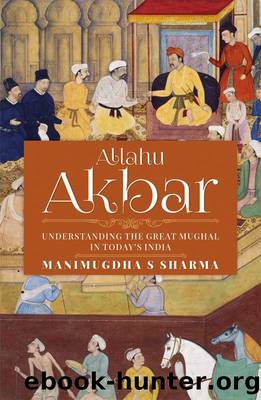
Author:Sharma, Manimugdha [Sharma, Manimugdha]
Language: eng
Format: epub
Publisher: Bloomsbury Publishing
Published: 2019-10-18T00:00:00+00:00
Chapter 6
Expanding to the East, Consolidating the West
For in war the result is from the stars
Not from wealth and a large army. 1
T he Sultanate of Gujarat was, to use a modern phrase, an âachhe din â 2 state. It was vast and prosperous, had flourishing commercial relations with countries in the Middle East and the Mediterranean, and was a military power that rivalled the Sultanate of Malwa, the Deccani sultanates and even the Delhi Sultanate. In fact, it was an offshoot of the Delhi Sultanate when the Tughlaqs were losing their grip on power, especially after the invasion of Amir Timur in the late 14th century.
The story of the Delhi Sultanate in its climacteric was like that of other empires in Indian historyâthe Mauryas, Guptas and Cholas before them, and the Mughals after them. As central authority weakened, provincial governors became independent and found their own kingdoms, resulting in the collapse of the empire.
In 1411, Zafar Khan, the wazir (governor in this case and not minister as is usually understood) appointed by the Delhi Sultan to run Gujarat, proclaimed his sovereignty and christened himself Sultan Muzaffar Shah. Only a century earlier, the Delhi Sultanate had taken Gujarat from the Rajput Vaghela dynasty when Sultan Alauddin Khilji defeated Raja Karan Dev II or Rai Karan as Muslim sources call him. The Delhi Sultans ruled their vast empire through deputies or viceroys, pretty much like the Mughals would do after them. These viceroys were called iqtadars and their provinces iqta s. Originally a Muslim practice from the land of the crescent, the iqta system was all about collecting taxes.
The system in the Delhi Sultanate also began similarly, though with time, it became more than revenue farming. An iqta became an elaborate system of administration during the early sultans, with iqtadars being appointed from Delhi and given a full but smaller version of the state apparatus to run. These were not permanent appointments with iqtadars being transferred around from one province to another. Also, iqtas were not hereditary positions. An iqtadar âs family could not inherit the appointment. That changed during Sultan Feroze Shah Tughlaqâs time when these were made hereditary possessions.
With their positions becoming permanent, the iqtadars could develop pretences of royalty, imitating the Delhi court. Over time, these viceroys became provincial magnets who attracted talent from all over. And gradually, iqtadar became synonymous with power and authority. That is probably why the Urdu word iqtidar has stayed with us and means power, authority or control.
In the late Mughal period, the subahdars or viceroys would act like the iqtadars and set up their own power blocs. Culturally and materially, in the mid-18th and early 19th centuries, the courts of Lucknow, Murshidabad and Hyderabad outshone the Delhi durbar. The Delhi durbar itself retained symbolic power and pre-eminence, but when it came to actual power, it wielded even less of it than smaller Mughal provinces like Sira 3 and Arcot. 4
The Sultanate iqtadars had a battery of state officials under them right down to the village administration level.
Download
This site does not store any files on its server. We only index and link to content provided by other sites. Please contact the content providers to delete copyright contents if any and email us, we'll remove relevant links or contents immediately.
| Anthropology | Archaeology |
| Philosophy | Politics & Government |
| Social Sciences | Sociology |
| Women's Studies |
Cecilia; Or, Memoirs of an Heiress — Volume 1 by Fanny Burney(32558)
The Great Music City by Andrea Baker(32018)
Cecilia; Or, Memoirs of an Heiress — Volume 2 by Fanny Burney(31956)
Cecilia; Or, Memoirs of an Heiress — Volume 3 by Fanny Burney(31940)
We're Going to Need More Wine by Gabrielle Union(19045)
All the Missing Girls by Megan Miranda(16023)
Pimp by Iceberg Slim(14506)
For the Love of Europe by Rick Steves(14121)
Bombshells: Glamour Girls of a Lifetime by Sullivan Steve(14073)
Talking to Strangers by Malcolm Gladwell(13370)
Norse Mythology by Gaiman Neil(13363)
Fifty Shades Freed by E L James(13239)
Mindhunter: Inside the FBI's Elite Serial Crime Unit by John E. Douglas & Mark Olshaker(9339)
Crazy Rich Asians by Kevin Kwan(9290)
The Lost Art of Listening by Michael P. Nichols(7506)
Enlightenment Now: The Case for Reason, Science, Humanism, and Progress by Steven Pinker(7311)
The Four Agreements by Don Miguel Ruiz(6763)
Bad Blood by John Carreyrou(6621)
Weapons of Math Destruction by Cathy O'Neil(6279)
